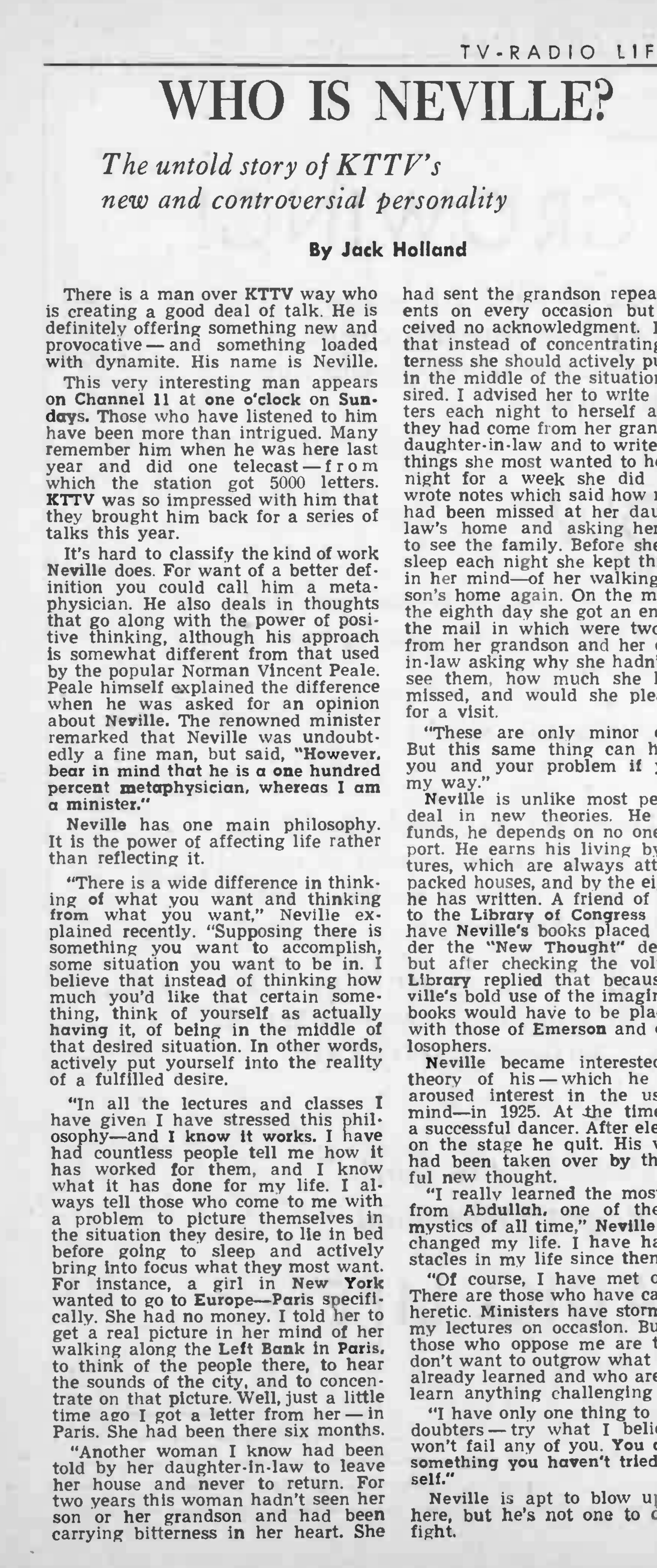
TV-Radio Life, April 15-22 1955, page 31 - feature article on Neville (KTTV era).
OCR from worldradiohistory.com scan; original is copyrighted press material - local
evidence copy, cite-with-credit only.
=== page 31 ===
TV-RADIO LIFE
WHO IS NEV
LE?
The untold story of KTTV’s
new and controversial personality
By Jack Holland
There is a man over KTTV way who
is creating a good deal of talk. He is
definitely offering something new and
provocative — and something loaded
with dynamite. His name is Neville.
This very interesting man appears
on Channel 11 at one o'clock on Sun-
days. Those who have listened to him
have been more than intrigued. Many
Temember him when he was here last
year and did one telecast—from
which the station got 5000 letters.
KTTV was so impressed with him that
they brought him back for a series of
talks this year.
It’s hard to classify the kind of work
Neville does. For want of a better def-
inition you could call him a meta-
physician. He also deals in thoughts
that go along with the power of posi-
tive thinking, although his approach
is somewhat different from that_used
by the popular Norman Vincent Peale.
Peale himself explained the difference
when he was asked for an opinion
about Neville. The renowned minister
remarked that Neville was undoubt-
edly a fine man, but said, “However,
bear in mind that he is a one hundred
percent metaphysician, whereas I am
a minister.”
Neville has one main philosophy.
It is the power of affecting life rather
than reflecting it.
“There is a wide difference in think-
ing of what you want and thinking
from what you want,” Neville ex-
plained recently. “Supposing there is
something you want to accomplish,
some situation you want to be in. I
believe that instead of thinking how
much you'd like that certain some-
thing, think of yourself as actually
having it, of being in the middle of
that desired situation. In other words,
actively put yourself into the reality
of a fulfilled desire.
“In all the lectures and classes I
have given I have stressed this phil-
osophy—and I know it works. I have
had countless people tell me how it
has worked for them, and I know
what it has done for my life. I al-
ways tell those who come to me with
a problem to picture themselves in
the situation they desire, to lie in bed
before going to sleep and actively
bring into focus what they most want.
For instance, a girl in New York
wanted to go to Europe—Paris specifi-
cally. She had no money. I told her to
get a real picture in her mind of her
walking along the Left Bank in Paris.
to think of the people there, to hear
the sounds of the city, and to concen-
trate on that picture. Well, just a little
time ago I got a letter from her —in
Paris. She had been there six months.
“Another woman I know had been
told by her daughter-in-law to leave
her house and never to return. For
two years this woman hadn't seen her
son or her grandson and had been
carrying bitterness in her heart. She
had sent the grandson repeated pres-
ents on every occasion but had re-
ceived no acknowledgment. I told her
that instead of concentrating on bit-
terness she should actively put herself
in the middle of the situation she de-
sired. I advised her to write little let-
ters each night to herself as though
they had come from her grandson and
daughter-in-law and to write the ver
things she most wanted to hear, Eac
night for a week she did this. She
wrote notes which said how much she
had been missed at her daughter-in-
law’s home and asking her to come
to see the family. Before she went to
sleep each night she kept this picture
in her mind—of her walking into her
son’s home again. On the morning of
the eighth day she got an envelope in
the mail in which were two notes—
from her grandson and her daughter-
in-law asking why she hadn’t been to
see them, how much she had been
missed, and would she please come
for a visit.
“These are only minor examples.
But this same thing can happen to
you and your problem if you’ll try
my way.”
Neville is unlike most people who
deal in new theories. He asks no
funds, he depends on no one for sup-
port. He earns his living by his lec-
tures, which are always attended by
packed houses, and by the eight books
he has written. A friend of his wrote
to the Library of Congress asking to
have Neville’s books laced there un-
der the “New Thought” department,
but after checking the volumes the
Library replied that because of Ne-
ville's bold use of the imagination the
books would have to be placed along
with those of Emerson and other phi-
losophers.
Neville became interested in this
theory of his—which he calls an
aroused interest in the use of the
mind—in 1925. At the time he was
a successful dancer. After eleven years
on the stage he quit. His whole life
had been taken over by this power-
ful new thought.
“I really learned the most about it
from Abdullah. one of the greatest
mystics of all time,” Neville said. “He
changed my life. I have had no ob-
stacles in my life since then.
“Of course, I have met opposition.
There are those who have called me a
heretic. Ministers have stormed out of
my lectures on occasion. But most of
those who oppose me are those who
don’t want to outgrow what they have
already learned and who are afraid to
learn anything challenging and new.
“J have only one tang ite say to the
doubters —try what I believe in. It
won't fail any of you. You can’t fight
something you haven't tried for your-
self.”
Neville is apt to blow up a storm
ne but he’s not one to dodge any
ight.
RECORD
to You
By ANDY MANSFIELD
(KFI, Monday thru Friday, 8:45 a.m.) :
(Saturday, 9:30 p.m.)
POD LP APP AP AP POD
With variety the keynote of this
week's long-play records, special em-
phasis is on “Hit The Deck” (MGM),
starring Tony Martin, Jane Powell,
Vic Damone, Russ Tamblyn, Debbie
Reynolds, Ann Miller and Kay Armen
in sound-track versions of songs from
the film based on Vincent Youmans’
great musical. Here are its many hits
— "Sometimes I’m Happy,” “Keepin’
Myself For You,” “I Know That You
Know,” “More Than You Know,” “Hal:
lelujah” and the
others—given new
life on the sound-
track of another
great MGM musi-
cal. . . . Another
i fine in-person re<
cording is that Co-
= lumbia LP by Mars
lene Dietrich. Ac-
tually recorded on
her opening night
at London’s fabu-
lous Cafe de Paris,
the listener is one
of the fortunate crowd who gathered
to welcome her that night, listen to
her introduction by Noel Coward, and
loudly applaud songs she has made
famous in films, on records and be-
hind the lines in World War I. The
excitement and charm of Dietrich are
faithfully captured on this recording,
and while her voice would win no
awards, there is the reserve, the per-
sonality and the femininity that is
only La Dietrich’s on this first night-
er performance.
“Music For Tonight” (Coral) fea-
tures piano solos by Steve Allen, to
lush backing of ‘his orchestra. This is
another Steve Allen, comedian, com-
poser and slock stopper: Here is the
musician, and, of the many person-
alities which combine to make Steve
Allen, here is one of the most appeal-
ing and memorable. Steve’s fingers
are adequately showcased on great
ballad standards of yesterday.
Trumpeter Charlie Shavers is fea-
tured on a great pair of LP’s on the
Bethlehem label. The first, “Horn of
Plenty,” features Shaver’s impressions
of famous names in “Story of the Jazz
Trumpet,” with narration by Al “Jazz-
bo” Collins; also included are three
top jazz renditions by the Shavers
Quintet. The second album, “The Most
Intimate,” finds Shavers in_ entirely
different mood and setting. This time
the lush muted strings of Sy Oliver
serve as a background for a serious
and imaginative Charlie Shavers play-
ing the misty music of Harold Arlen
and Johnny Green in beautiful inter-
pretations, A.M.
Pane Thirty-one
- 15 April 1955
- 15 April 1955
from Abdullah. one of the greatest
mystics of all time,” Neville said.